



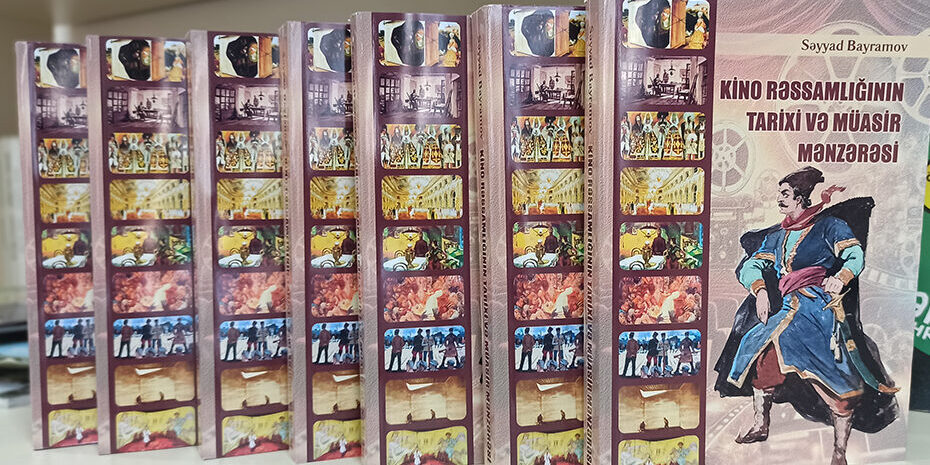
The aforementioned book has been published with the financial support of AUF and Azerbaijan Union of Artists.
Authored by Sayyad Bayramov — a member of the Azerbaijan Union of Filmmakers, an artist, and a candidate of art history — the book explores the contributions of prominent Azerbaijani film production designers and traces the developmental trajectory of cinematic art throughout the nation’s history.
It is worth noting that the primary distinction of this research work from previous publications lies in its comprehensive approach to the subject matter, offering in-depth analysis across all major aspects of the topic. The book, structured in two parts, begins in Part I with an exploration of the role of the production designer in narrative cinema — examining the nature, essence, and aesthetic characteristics of their work. It offers a detailed examination of the fundamental principles of narrative cinema as an art form, the visual language of film, the artistic essence of feature filmmaking, the interplay between visual creativity and cinema, as well as the role, tools, and expressive potential of visual art within the filmmaking process. Part II focuses on the formation and developmental stages of production design in Azerbaijani cinema.
Reflecting on the distinctive features of cinematic art — particularly production design — the author offers valuable insights and guidance for young individuals aspiring to enter the field. He also notes that the inclusion of production sketches from renowned artists of various generations, as well as illustrative design materials used in completed films, represents a significant contribution in terms of the field’s specialized terminology and visual documentation.
While discussing the distinctive features of cinematic art — particularly production design — the author offers valuable guidance to young individuals pursuing this profession. He also emphasizes that the inclusion of successful film sketches by production designers from various generations, along with illustrative materials from completed films, represents a noteworthy innovation in terms of enriching the field’s terminological vocabulary and visual archive.
Intended for a broad readership, the book was edited by Honored Art Worker Rafig Guliyev. Peer reviewers include People’s Artist Hamida Omarova, PhDs in Art Studies Vidadi Gafarov and Farida Guliyeva. The publisher and typist is Elnara Abbasova and Roya Nasirova respectively while technical editing by Asim Safarov, design by Irada Ahmadova.
In the foreword, the author, Sayyad Bayramov, emphasizes that along with a deep understanding of cinema, a solid grasp of visual art is equally essential. He notes that the production designer is the creator of cinematic space — and space is always geometry: “This means that studying production design also partly relies on mathematical sciences. It is the production designer who constructs the environment for the director’s creative action. Their work is one of the key factors that defines the visual approach of the cinematographer. The talent and skill of the production designer can also subtly influence the actor’s performance.”
aki.az